
Rusk County Bench Warrants Explained
A bench warrant is what a judge directs after someone misses a court obligation. That could be a skipped appearance date, an unpaid fine, or an ignored instruction. The judge and the case level matter a great deal here. A felony file moves differently than a JP traffic case or a municipal citation, even when people call the paperwork by the same name. One thing Rusk County does not have is a single public bench-warrant database. Your best starting points are the notice, the citation, or the clerk of the court where the case was heard.
Rusk County JP Rules and Missed Settings
Rusk County runs five JP precincts, each with its own clerk for fine-only and traffic matters. Local rules updated August 15, 2025 lay out that five-precinct structure. A missed setting in JP1 stays with JP1. It never reroutes to JP4 just because both are county courts. Go by the precinct printed on the ticket, confirm the case number, and ask whether the docket shows a new setting or a court process. The District Court and County Court at Law keep separate calendars and clerk routes. A public docket date is helpful context, not proof a warrant issued.
How Rusk County Bench Warrants Are Issued
Every bench warrant starts with a case and an obligation, like an appearance date or a payment deadline. Miss it, and a judge or authorized judicial officer may direct process under the rules for that case. The issuing clerk records the action, and an authorized law-enforcement officer may serve the order. What the process is called, and how you get the case back before the court, turns on its level and posture. In Rusk County, the Fourth Judicial District Court lists its coordinator at 903-657-0358, and the District Clerk's criminal-record line is 903-657-0353. County Court at Law settings route through the County Clerk under local rules.
Rusk County Bench-Warrant Search Does Not Start With the Calendar
The District Court criminal calendar posts arraignment, grand-jury, trial, and docket-call dates. Useful, but limited. A calendar is not a searchable list of bench warrants, and a setting can move or be canceled without notice. Treat it as a starting point only. Then call the court coordinator with the cause number in hand. A case on the docket does not mean a warrant exists. No listing does not mean the case has ended. The official calendar shows the scheduled criminal proceedings for Rusk County.
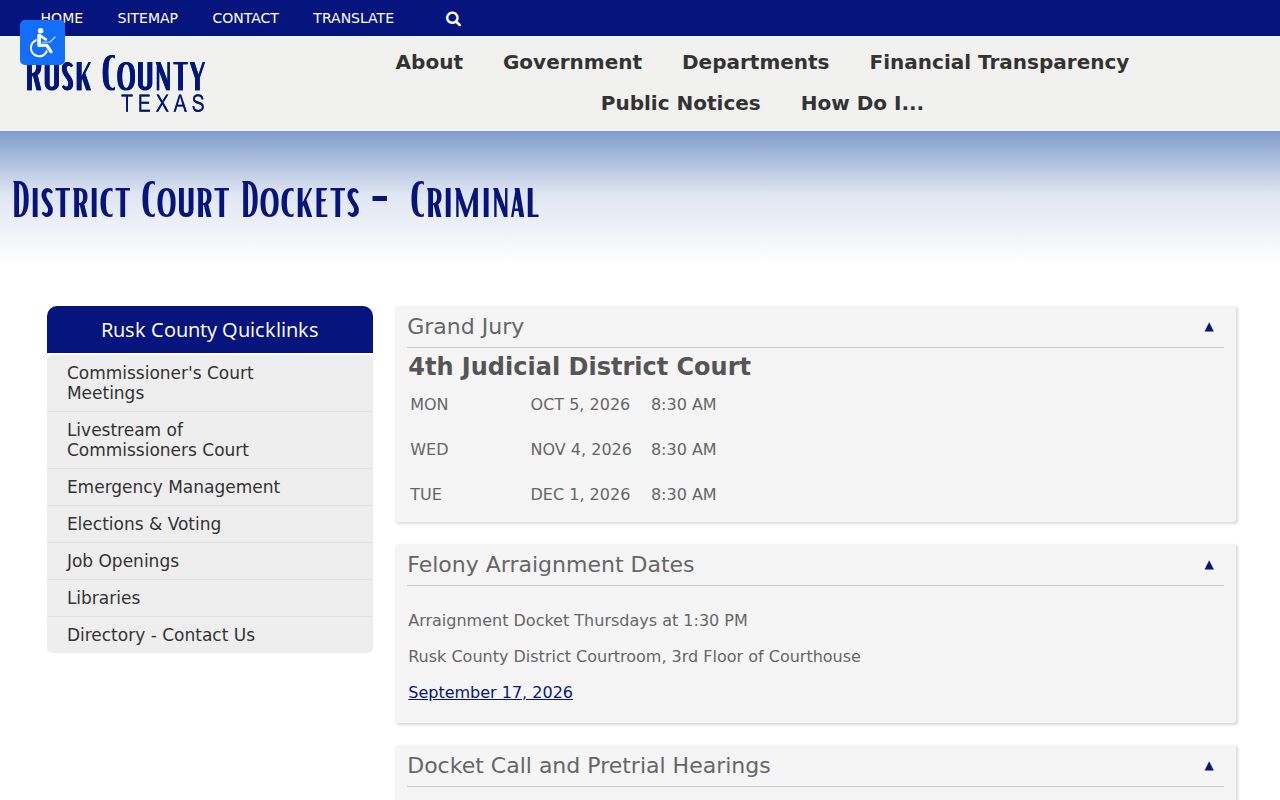
Ask the clerk about the current case entry and any order tied to it.
Bench Warrants and Arrest Warrants Compared
Both kinds can put a person in custody, but they begin differently. A bench warrant grows out of a court obligation in a case already open. An original arrest warrant follows a probable-cause process tied to an alleged offense. A capias, or capias pro fine, is a court-directed writ that can bring someone before a judge, often in fine-collection settings. Ask the Rusk County clerk which process was actually issued. The label alone will not tell you.
| Question | Bench warrant or capias | Original arrest warrant |
|---|---|---|
| Why it begins | Missed setting, unpaid fine, or failure to comply | Judicial probable-cause determination in an investigation |
| Case stage | Usually follows an existing court case or order | May begin a criminal case or authorize arrest |
| First contact | Issuing court clerk or counsel | Issuing court, counsel, or authorized agency |
| Resolution | May involve a reset, motion, appearance, payment, or bond | Requires case-specific advice and court process |
Rusk County Bench Warrant and Capias Terms Depend on the Court
Texas courts distinguish a capias or capias pro fine from an original arrest warrant. Rusk County's own pages offer no countywide glossary, though. A payment obligation may produce a fine-collection process, while a missed date leads to a different court action. Do not assume the sheriff can recall a capias. Paying a listed balance does not automatically clear a separate process either.
- Bench warrant
- Court process tied to a missed obligation or order in a pending case.
- Capias pro fine
- A court-directed fine-collection process; ask the issuing clerk what applies.
- Recall or quash
- A court action that withdraws or sets aside process under the court's rules.
Resolving a Rusk County Bench Warrant
First, verify the issuing court, the case number, and the process name. Then ask the Rusk County court what routes it allows: a new setting, a motion to recall, a payment plan, an appearance, a bond, or something else. Confirm whether a judge must approve the request, whether fees remain, and when the recall gets recorded. Keep your receipt or written docket confirmation, and ask whether a separate license hold still stands.
Before appearing: If the case is a felony or the consequences are unclear, consult an attorney before deciding to surrender, pay, or make a statement.
A relative can gather case details for a Rusk County bench warrant, but the named person should follow counsel's advice and the court's instructions.
Rusk County Missed-Court Steps Vary by Case
One practical call can settle which office owns the next step in Rusk County. Give the clerk your citation or cause number, explain the missed date, and ask what is now on the docket. Then ask whether an appearance must come before payment, whether a motion is required, and how long a recall takes to reach the serving agency. Until the court confirms its record, treat the case as open. The routing depends on the case. A JP case goes to the correct precinct. A city citation goes to that municipal court. A district criminal file goes to the District Clerk or the coordinator identified on the Rusk County court page.
Which Rusk County Court Issued the Warrant
Figuring out which court issued a Rusk County warrant narrows your next step. The county runs a Fourth Judicial District Court, a County Court, and a County Court at Law. Five JP courts sit alongside municipal courts in Henderson, Kilgore, Overton, Tatum, and Mount Enterprise. Each level keeps its own records. The County Clerk handles the county-level route, while the District Clerk holds the Fourth District's documented criminal files. A city court is separate from any JP precinct that shares its town, so do not assume they cross-file. If you never received notice, tell the clerk or a lawyer what you recall about the hearing, ticket, or court location. The courthouse sits at 115 N. Main Street in Henderson, though the right office and floor depend on the court.
Rusk County Bench-Warrant Records Have Access Limits
Not every Rusk County bench-warrant record is open. Some affidavits and warrants stay sealed, and juvenile records get extra protection. A public-information request works for records a government office holds. A judicial record, though, may fall under Rule 12 or court-specific fees and access rules. Ask what can be released. The request may belong with a clerk rather than the sheriff. An index result is not legal advice, and it cannot replace the court's current direction. For broader county routes and public-access rules, see the Rusk County warrant records overview.